
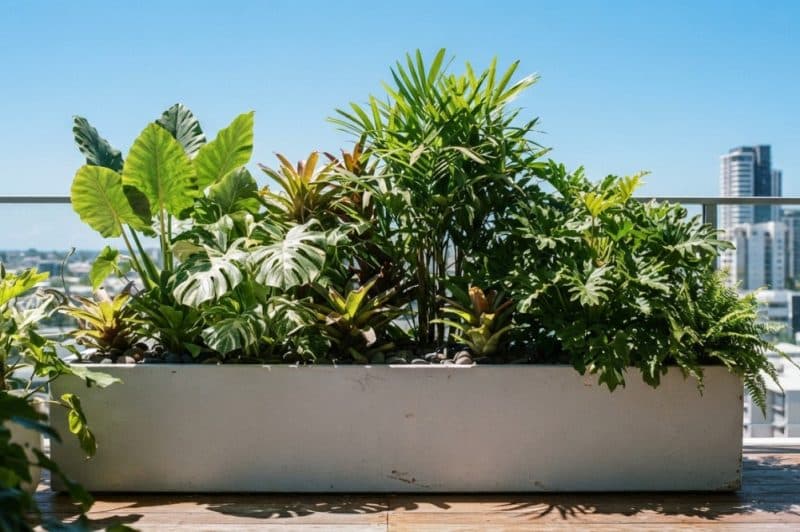
If you were to place your hand on a dark steel planter exposed to the Queensland sun on an afternoon in January, you wouldn’t leave it there long. Not only would the planter wall itself be hot, but the soil pressed against the inside of that wall is heating up, and the roots sitting inside would be feeling the heat as well. That’s the part of choosing a planter box material that rarely comes up when the decision gets made from looks alone.
In the southern states, summer is something a garden gets through. In Queensland it takes up most of the year. The UV index sits in the extreme range on clear summer days, the humidity barely lifts overnight, and from around November the afternoon storms can dump a serious amount of rain in under an hour. A planter has to cope with all of it, every season, for years.
How much the planter box material changes root temperature
The root zone is where extreme heat does its real damage. A plant in the ground has metres of cooler soil around it. A plant in a box has whatever sits between it and the wall, and a thin wall in full afternoon sun passes that heat straight through. Roots along the western side of a box run warmer than the ones in the middle, and the plant shows it in scorched leaf tips and a thirst that no watering schedule seems to keep up with. Anyone hunting for heat resistant planter boxes is really shopping for a wall that slows that transfer down.
Why fibreglass planter boxes suit most Queensland spots
Fibreglass doesn’t conduct heat the way metal does, so the roots get a buffer a steel wall can’t give them. Go with a pale finish (white, light grey, a sandstone tone) and the box bounces a good share of the sun back before it ever reaches the soil. Black fibreglass still gets hot, to be fair, but nowhere near as hot as black steel, though.
Weight helps fibreglass too. The lighter frame found on these products makes them more versatile for use on balconies and upstairs decks, which plenty of apartments and units rely on for their only outdoor space.
UV exposure is the only real weak point of these planters. Over time, resins can chalk and fade, and this process is often sped up under the Queensland sun. The average life span can vary greatly, with anything from 5 to over 15 years depending on placement.
Corten steel planter boxes in Queensland: where they work and where they don’t
Honestly? Corten gets oversold for subtropical gardens. Its protective patina relies on the surface getting wet and then drying out properly, over and over. Weeks of heavy humidity interrupt that rhythm, and salt air drifting in off the coast is worse, leaving the surface to keep corroding when it should be settling. Bayside suburbs and anywhere with a water view are the riskiest spots to put one.
Storms can bring a second problem. Fresh corten sheds rust-coloured water for roughly its first year, and a heavy downpour carries it straight across pale pavers, concrete or light decking. Those stains don’t always scrub out easily, but this shouldn’t rule corten out. A ground-level bed away from the coast, with some afternoon shade and a gravel strip around the base to catch run-off, can look great for a very long time.
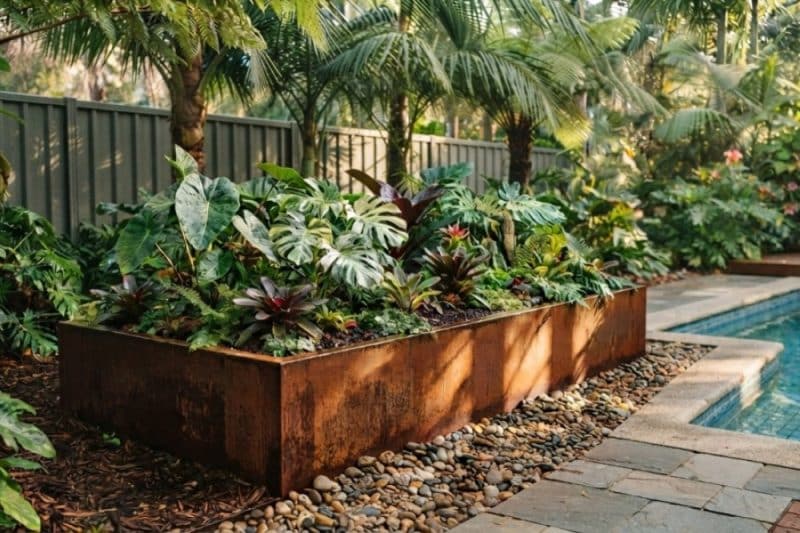
Heat into the root zone can still be a risk, so a deeper box, an insulating liner along any sun-facing walls and tough, heat-hardy planting all can help.
Stand where the box is going at 3pm
The spot decides the material far more than the catalogue does.
- Full western sun with no shade after lunch: light-coloured fibreglass, and go bigger than seems necessary, since more soil means a slower temperature swing.
- Balcony, rooftop, anything upstairs. Fibreglass, mainly for the weight.
- Close to the coast? Probably skip corten altogether.
- Inland, at ground level, with a bit of shade and somewhere for run-off to drain, corten earns its place.
- Pale pavers running right up to the planter are worth a second thought before going with steel.
Whatever the box is made from, five centimetres or so of mulch across the top keeps the soil surface noticeably cooler than bare dirt through a Queensland January. Bamboo Plus delivers anywhere in QLD, and the team can talk through sizes, colours and finishes for planter boxes in Brisbane, the Gold Coast or further out before you commit to something that has to survive the next ten summers.